- Blog
Still Curtailing Using a Flat Strike Price? You’re Leaving Money on the Table

Every hour your fleet runs, power price, hash price, and ambient temperature are all moving. Most operations are not keeping up with that movement. The result is not just inefficiency. It is profit that does not show up on your balance sheet. OBM | Foreman was built to close that gap, and with Price Response Plus, we have made the most sophisticated fleet power management available to any operator running in a variable-priced market.
Expanded Capabilities with Price Response Plus
Price Response Plus expands on Foreman’s existing Price Response capability with four core upgrades:
- Three Automated Curtailment Strategies: Basic (on/off), Power Mode, and Wattage Target, which targets the exact wattage that maximizes profit at any price point, including overclocking or underclocking wattage based on what is currently most profitable. Foreman calculates optimal strike prices per miner model in real time, factoring in power price, hash price, and network difficulty. No manual math, no spreadsheets.
- Manual Strike Options: Sophisticated operators retain full control. Define your own strike prices manually or push updates programmatically from your own pricing algorithm via API (coming soon). You own the logic; Foreman handles fleet-level execution.
- For Hosting and Co-Lo Facilities: Configure independent strike prices and strategies for each hosted customer’s machines rather than forcing a single configuration across the site.
- Safety Measures: Configurable delay settings prevent rapid power cycling that damages hardware during short-lived price fluctuations. An emergency shutdown price bypasses those delays entirely and immediately curtails the fleet when prices spike abnormally, so your machines are never exposed to a catastrophic price event.
- Broad Market and Program Compatibility: Foreman supports a market-leading number of LMP pricing nodes and operates across real-time, hourly, and day-ahead market structures. If participating in ancillary programs such as ECRS, Foreman will automatically maintain the awarded load to meet your commitment while curtailing the remaining load based on strike price.
Why It Matters
The default in most mining operations is a single, flat strike price applied to the entire fleet. It is a practical choice because calculating accurate, per-model strike prices is operationally difficult without the right tools. But choosing a flat strike price is likely limiting your site’s income.
In addition, with advances in firmware that support low and high power modes and wattage targets, Foremen now allows for more granular steps and precise adjustments to capture more efficiency and profit. Foreman provides the broadest support including Avalon, Whatsminer, and Bitmain running leading third party firmware including Vnish, Braiins and LuxOS.
OBM’s internal simulation data, based on an S19j Pro running on real-time ERCOT West Load Zone pricing from 2023 to 2025, tells the story directly. A flat $100 strike price outperforms no strike at all by over 23%. But compared to a wattage target optimization strategy using our Auto Strike algorithm, that same flat strike still leaves more than 12% in margin unrealized. The gap grows further as fleet size scales.
There is also the temperature variable. Miner efficiency degrades with heat, so the correct strike price for a machine at noon is materially different from what it was at 8 AM. A static strike price cannot account for that. Auto Strike recalculates continuously, which means your curtailment thresholds stay accurate across the full operating day.
For sites participating in demand response or ancillary programs, there is an additional risk: miners curtailed on real-time price may not have load available when an ancillary commitment is triggered the next day. Ancillary Reserve eliminates that conflict by isolating the committed load from price-based curtailment logic.
The Revenue Opportunity
The simulation results below, compared to a flat strike price, show the monthly profit increase per miner across strategies, using an S19j Pro on ERCOT LZ West load zone real-time pricing from 2023 to 2025. These are not projected estimates. They are backtested results against actual market conditions.
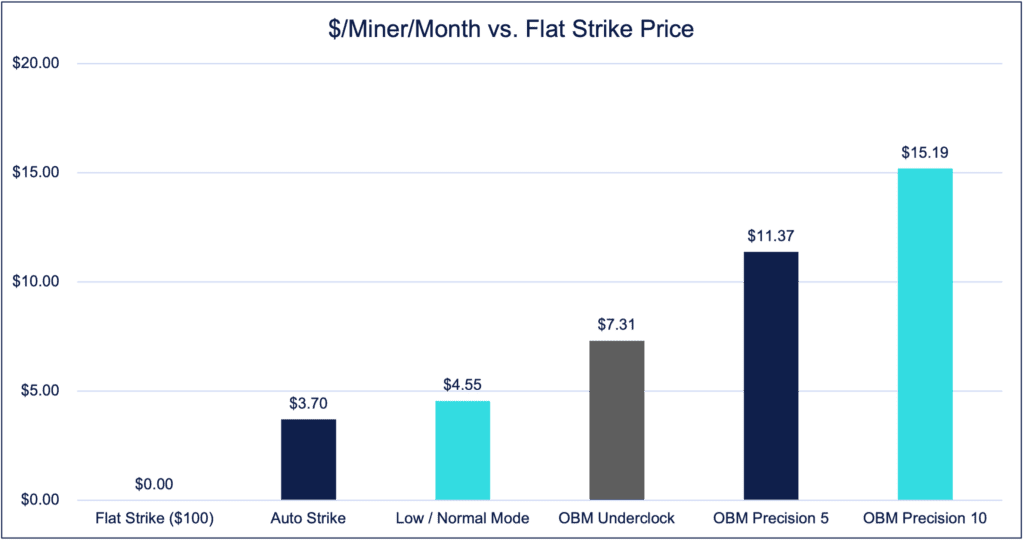
Simulation based on S19j Pro, ERCOT West Load Zone real-time pricing, 2023-2025. Constant temperature assumed; wear and tear not factored.
At scale, the numbers compound quickly. A 500-machine operation running OBM Precision 10 versus a flat strike generates an additional $7,600 per month, or over $91,000 per year. At 1,000 machines, that figure exceeds $182,000 annually. Across a portfolio of sites, precision optimization becomes one of the highest-returning operational investments available.
Comparing revenue potential against mines using no strike price is even greater, showing a 38% increase in profit per miner.
Built on Years of Miner Intelligence
The optimization logic behind Price Response Plus is not theoretical, but real and available today. OBM has managed hundreds of miner types over years in production. Foreman has managed loads exceeding 500 MW and integrated into major demand response programs globally.The machine learning models that power our Auto Strike algorithm are trained on that data and experience.
Price Response Plus is available as an add-on for Foreman customers and as a free upgrade for current Cost Avoidance customers.
Contact us to schedule a demo.
Subscribe to OBM’s Blog
More from OBM
Gridmatic Launches OBM’s Daily Settlement and Automated Load Control Solution for Large Flexible Loads

OBM Launches Behind-the-Meter Load Management Solution to Improve Real-Time Energy Monitoring

Key Takeaways from the ERCOT Market Summit