- Blog
From Estimates to Evidence: Foreman Intelligence Provides Finance Execs with Real Numbers in Real Time
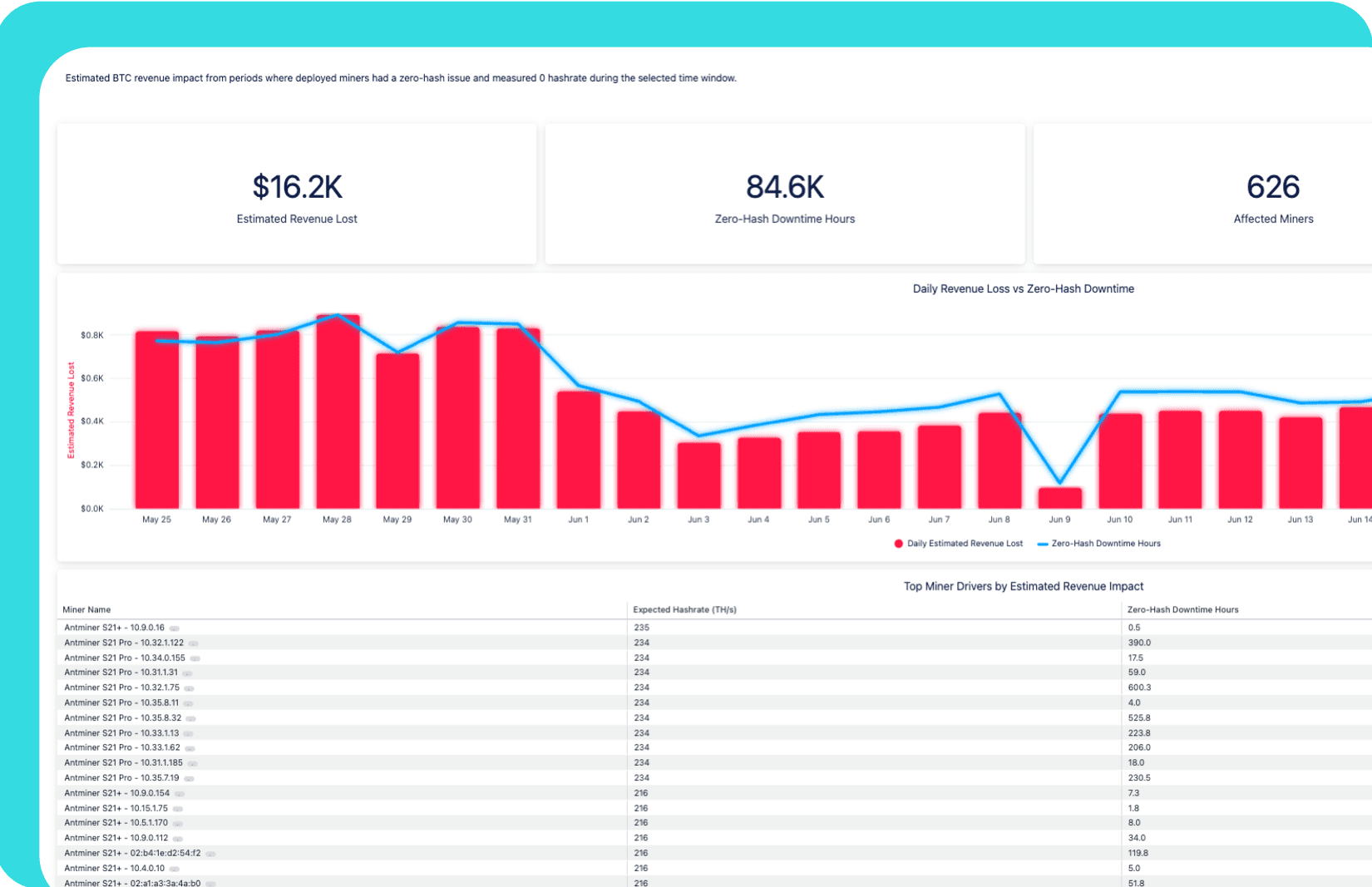
If you’ve been in a board meeting or investor call in the last 18 months, you know the questions have changed. A few years ago, the conversation was about scale. How many megawatts, how many miners, what’s the growth plan. Today, the questions are sharper: What’s your actual cost per coin? How does your margin hold up when hash price drops 20%? What happened to power costs last quarter, and why?
These are reasonable questions. They’re the questions any finance leader would ask of a capital-intensive business operating in a volatile commodity market. The problem is that most Bitcoin mining companies aren’t set up to answer them in real time, or sometimes at all, without a significant amount of manual effort.
Real-Time, Fleet-Wide Analytics
Foreman Intelligence is the advanced analytics platform for Bitcoin miners at scale, built on the miner management data that Foreman already collects and enriched with external inputs: LMP prices, hash price, Bitcoin market data, infrastructure status, and weather. The result is a unified view of the business across every site, updated continuously, without requiring anyone to export a file or run a query.
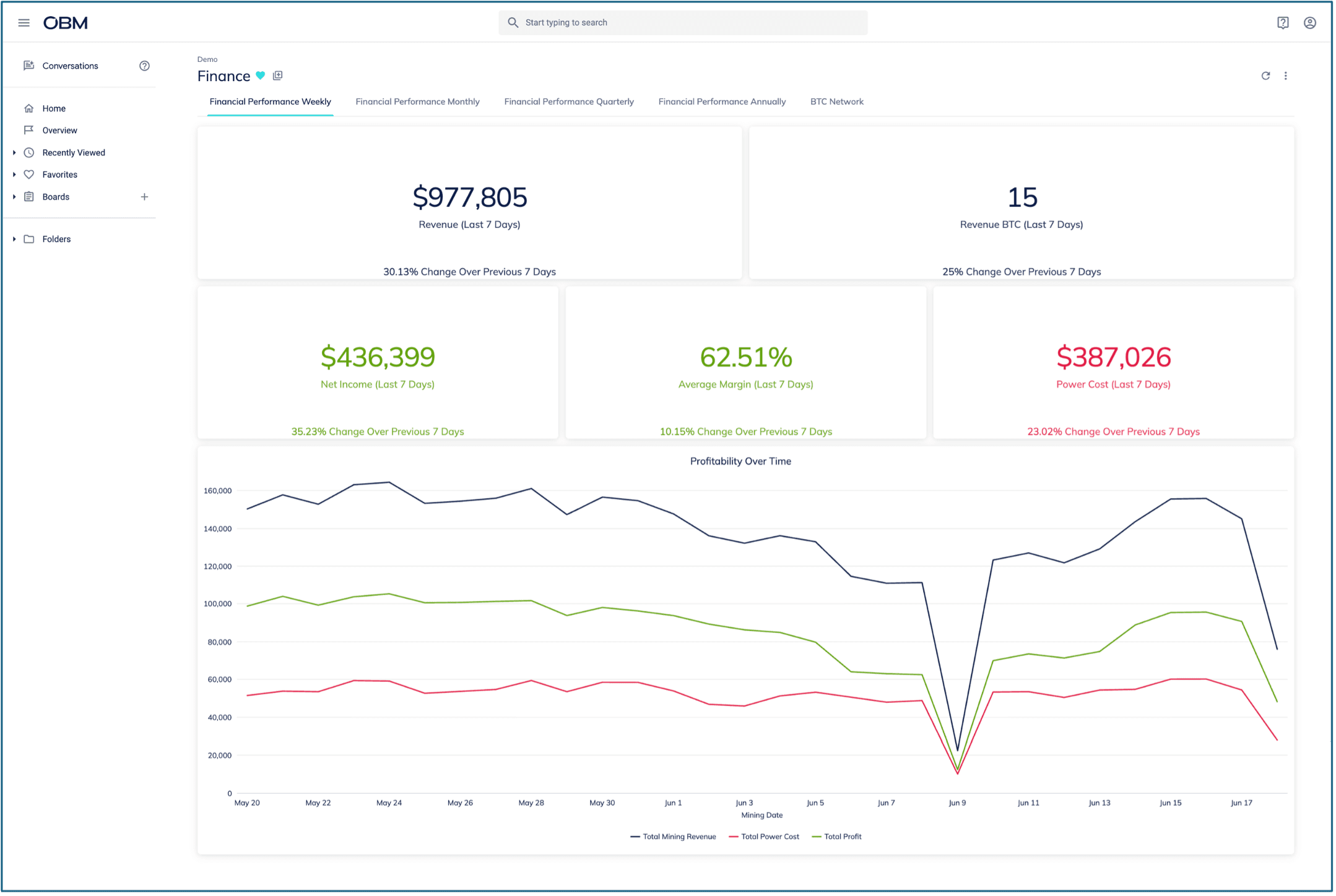
For finance and executive leaders, the out-of-the-box Finance Dashboard covers the numbers that matter most:
- Revenue and net income, current period and percentage change versus prior period
- Average fleet margin trended over time
- Power cost by site, broken down by rate, consumption, and curtailment events
- Curtailment P&L: demand response revenue earned alongside mining revenue foregone, for every event
- Bitcoin price and difficulty, current and trended, in the same view as your operational data
In addition, custom reports are easily created. Built on Google’s Looker Studio, Foreman Intelligence gives your team the ability to easily build reports against your fleet data without writing code.
Cost-per-coin shouldn’t be a back-of-envelope number
Mining operations generate a lot of data. Every miner, every site, every curtailment event, every power draw, every hashrate fluctuation is logged somewhere. The issue isn’t data availability. It’s that the data lives in separate systems, gets exported into spreadsheets, and requires someone to analyze it before it means anything.
Cost-per-coin calculations depend on pulling precise power consumption data from one system, applicable rates from another, and hashrate output from a third. When those systems don’t talk to each other automatically, the calculation is as good as the last time someone ran it. If power costs spiked mid-month, or a site underperformed during a curtailment window, the margin report won’t reflect it until someone notices, pulls the right files, and does the math.
For a single-site operation, this is manageable. For a multi-site fleet, it’s a structural problem. Finance ends up reporting estimates, not actuals. And when the board or an auditor asks where a number came from, the honest answer is often a spreadsheet that someone built manually.
What “audit-ready” actually means for mining
The standard is getting higher. Institutional capital, public market scrutiny, and the general maturation of the industry all point in the same direction: mining companies need the same financial infrastructure discipline that any capital-intensive business is expected to have. That means data with lineage. Numbers that are traceable to their source. Reporting that doesn’t have to be assembled after the fact because someone asked for it.
That’s a different standard than most mining finance teams are currently operating against, through no fault of their own. The tools haven’t existed in a form that’s practical for this industry.
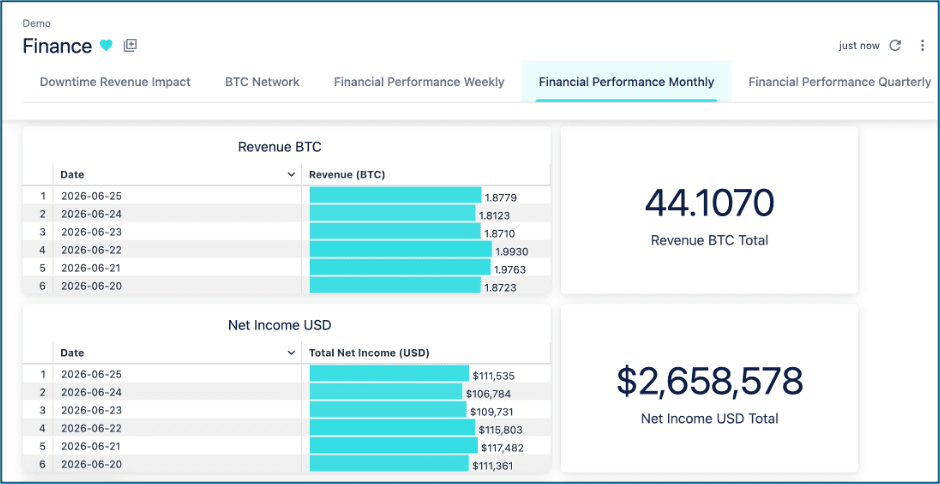
These aren’t reports someone builds on request. They’re live, they’re consistent across every site in the fleet, and the underlying data is fully traceable.
Don’t file a ticket. Ask the AI Analyst.
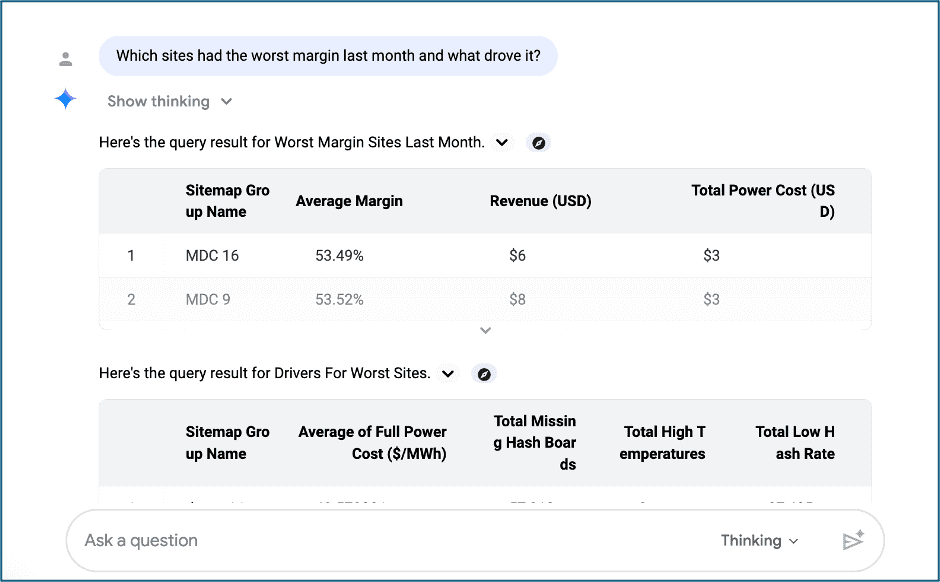
The AI Analyst capability takes it a step further. Finance leaders can ask direct questions in plain language and get answers grounded in actual fleet data, without writing SQL, opening a ticket, or waiting on an analyst. “Which sites had the worst margin last month and what drove it?” is a thirty-second question, not a half-day project.
Why this matters now
The Bitcoin mining industry is past the stage where operating on estimates is a reasonable position. Hash price volatility, power cost exposure, curtailment economics, and hardware depreciation are all decisions that require real numbers, not approximations. The organizations that build the data infrastructure to support real-time financial visibility now will be better positioned for the institutional conversations, the regulatory environment, and the competitive landscape ahead.
Finance shouldn’t be the last department to see what happened last month. It should be the first to know what’s happening right now.
If you want to see what it looks like for your fleet, reach out to set up a demo.
Subscribe to OBM’s Blog
More from OBM

OBM Announced as a Finalist for the Platts Global Energy Awards

Global Tech Awards Honors Season 2 Winners from 13 Countries Across 40 Technology Categories

Brief Glance: Flipping the Switch: OBM’s Tech Turns Energy Costs into Profit